

In this article
- Key takeaways
- Official figures at a glance
- How this page was compiled
- What do official sources mean by ransomware?
- What did the FBI IC3 record in 2025?
- What do the official ransomware numbers leave out?
- What does ENISA report for the EU?
- How do the official U.S. and EU pictures compare?
- What do CISA and the FBI recommend?
- FAQ
- How much money was lost to ransomware in 2025, according to the FBI?
- Is ransomware the most common form of internet crime in the FBI data?
- Can the FBI and ENISA totals be added together?
- If reported ransomware losses fell from 2023 to 2025, is the threat shrinking?
- Where should a victim report a ransomware incident?
- Sources
- Changelog
The FBI’s IC3 recorded 1,008,597 complaints and $20.877 billion in reported losses in 2025. Ransomware accounted for 3,611 complaints and $32,320,105 in reported losses, a figure the FBI calls artificially low. ENISA’s 2025 Threat Landscape found ransomware the most directly impactful cybercrime threat in the EU, though DDoS made up most of the 4,875 incidents it reviewed.
Key takeaways
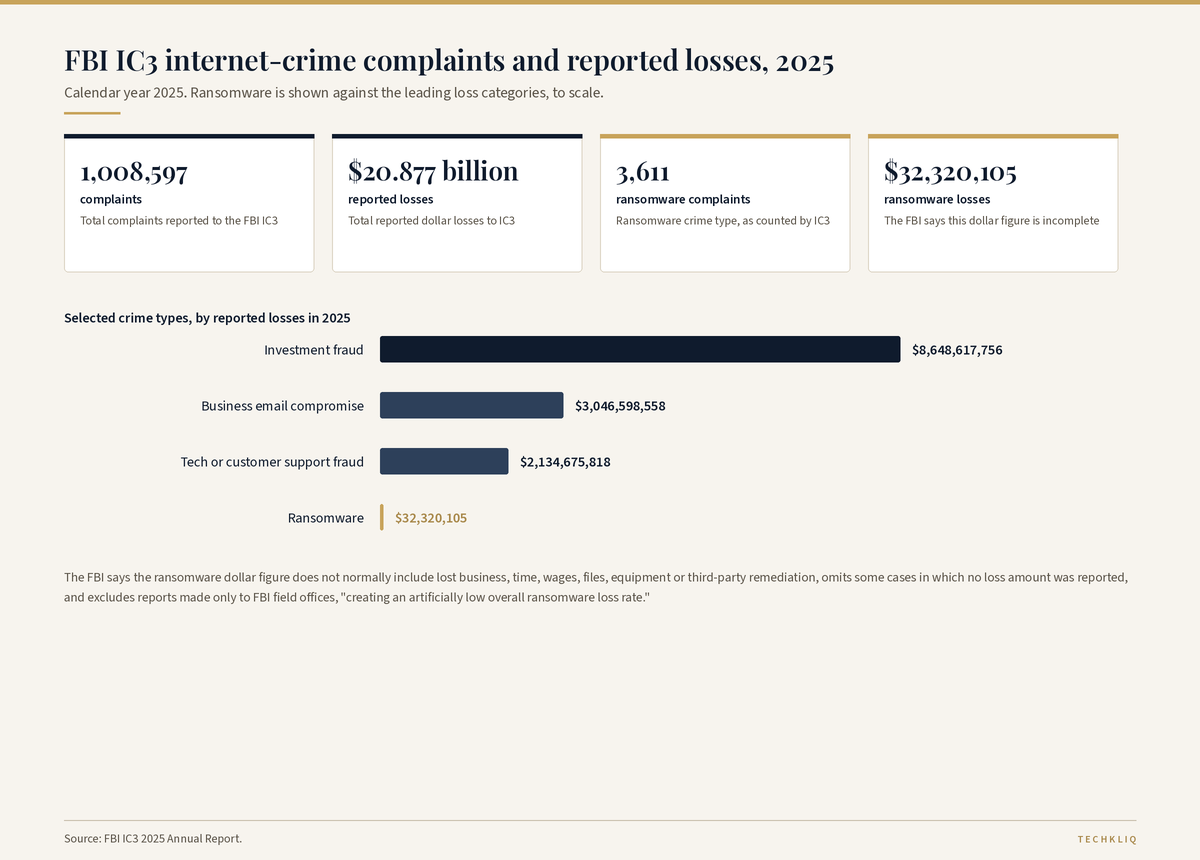
- In calendar year 2025, the FBI Internet Crime Complaint Center (IC3) recorded 1,008,597 complaints and $20.877 billion in reported losses, a 26% increase in losses from 2024 (IC3 2025 Annual Report).
- Ransomware was 3,611 of those complaints, with $32,320,105 in reported losses. Complaint counts rose from 2,825 in 2023 and 3,156 in 2024. Reported ransomware losses were $59,641,384 in 2023, $12,473,156 in 2024 and $32,320,105 in 2025 (IC3 2025 Annual Report, three-year comparison tables).
- The FBI says the ransomware dollar figure does not normally include lost business, time, wages, files, equipment or third-party remediation, and excludes reports made only to FBI field offices, “creating an artificially low overall ransomware loss rate” (IC3 2025 Annual Report).
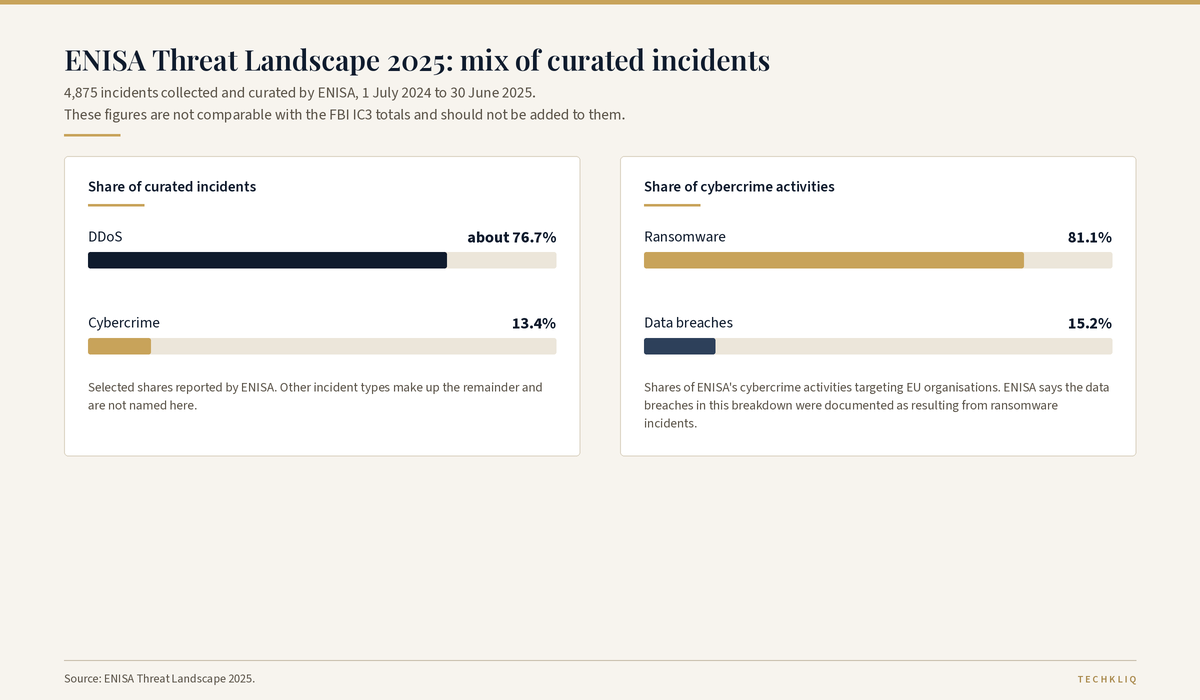
- ENISA’s Threat Landscape 2025 reviewed 4,875 incidents from 1 July 2024 to 30 June 2025. DDoS made up about 76.7% of recorded cases. Cybercrime was 13.4% of all incidents, and ransomware accounted for 81.1% of those cybercrime activities. ENISA calls encrypting ransomware the most directly impactful cybercrime threat (ENISA Threat Landscape 2025).
- CISA and the FBI define ransomware as malware that encrypts files and then demands payment. CISA also describes “double extortion,” in which stolen data is used to pressure victims. CISA did not publish a comparable annual loss total in the materials reviewed for this page (CISA StopRansomware; #StopRansomware Guide).
Official figures at a glance
Figures below are taken from the official reports named in the source column. The FBI and ENISA do not measure the same thing, or the same period, and their totals should not be added together.
| Figure | What it measures | Source | Date / period | Notes |
|---|---|---|---|---|
| 1,008,597 complaints; $20.877 billion in reported losses | All internet-crime complaints and dollar losses reported to the FBI IC3 | IC3 2025 Annual Report | Calendar year 2025 | Official accessibility text also records a 26% increase in losses from 2024 and a $20,699 average loss |
| 3,611 ransomware complaints; $32,320,105 in reported ransomware losses | Ransomware crime type, as counted by IC3 | IC3 2025 Annual Report | Calendar year 2025 | The FBI says this dollar figure is incomplete |
| 2,825; 3,156; 3,611 ransomware complaints | IC3 ransomware complaint counts | IC3 2025 Annual Report, three-year count table | 2023; 2024; 2025 | Counts rose in each of the three years shown |
| $59,641,384; $12,473,156; $32,320,105 | IC3 reported ransomware losses | IC3 2025 Annual Report, three-year loss table | 2023; 2024; 2025 | Reported losses fell in 2024, then rose in 2025, and remained below the 2023 total |
| 63 new ransomware variants; 5.25 new variants a month on average | Variants identified via IC3 | IC3 2025 Annual Report | Calendar year 2025 | The ten most frequently reported variants accounted for 56.8% of ransomware incidents and 49.8% of reported ransomware losses |
| 4,875 incidents | Incidents collected and curated by ENISA | ENISA Threat Landscape 2025 | 1 July 2024 to 30 June 2025 | Drawn mainly from open sources, plus anonymised information from EU Member States and ENISA partners. ENISA says this is not a complete picture |
| About 76.7% DDoS; 13.4% cybercrime | Share of ENISA’s curated incidents | ENISA Threat Landscape 2025 | Same period | DDoS was the dominant incident type by volume |
| 81.1% ransomware, 15.2% data breaches | Share of ENISA’s cybercrime activities targeting EU organisations | ENISA Threat Landscape 2025 | Same period | ENISA says the data breaches in this breakdown were documented as resulting from ransomware incidents |
| 82 ransomware variants; Akira 11.6%, SafePay 10.1%, Qilin 7.5% | Variants reportedly deployed against organisations in EU Member States | ENISA Threat Landscape 2025 | Same period | A different metric from IC3’s count of newly identified variants |
How this page was compiled
This page uses the FBI’s IC3 2025 Annual Report for U.S. complaint counts and reported losses, with prior-year rows taken from that report’s three-year tables (and checked against the IC3 2024 Annual Report where the same figures appear). EU figures come from ENISA Threat Landscape 2025, dated October 2025, with the official ENISA press release of 1 October 2025 and ENISA’s 2025 booklet used only as supporting official summaries. Definitions and reporting advice come from CISA's StopRansomware pages and the joint #StopRansomware Guide (version 3.0, October 2023). Vendor blogs, insurance estimates, law-firm round-ups and unofficial spreadsheets were excluded. CISA was not treated as a source of an annual ransomware loss total, because the CISA materials opened for this page do not publish one. Figures are current as of 17 November 2026. If a later official report revises a number, this page should be updated. Corrections are covered by Techkliq’s editorial policy.
What do official sources mean by ransomware?
The FBI IC3 defines ransomware as “a type of malicious software designed to block access to a computer system until money is paid” (IC3 2025 Annual Report, Appendix B). CISA’s wording is close, and adds the effect on the systems that depend on those files: ransomware “encrypt[s] files on a device, rendering them and the systems that rely on them unusable,” after which attackers “demand ransom in exchange for decryption” (CISA StopRansomware; #StopRansomware Guide).
CISA also describes a second pressure tactic. Attackers “have also exfiltrated victim data and pressured victims to pay by threatening to release the stolen data. The application of both tactics is known as ‘double extortion.'” In some cases, CISA says, data theft and the threat of release are used “as their sole form of extortion without employing ransomware” (#StopRansomware Guide).
Those definitions matter when reading the numbers that follow. A complaint or incident labelled ransomware in one report is not automatically the same event as a data-extortion case in another, and a reported loss is not the same as the full cost of an attack.
What did the FBI IC3 record in 2025?
IC3 is the FBI’s public reporting centre for internet-enabled crime. In its 2025 annual report, the centre said it now averages almost 3,000 complaints a day. For calendar year 2025 it recorded 1,008,597 complaints and $20.877 billion in reported losses, a 26% increase in losses from 2024. The official accessibility text also gives a $20,699 average loss (IC3 2025 Annual Report). The 2024 report had put that earlier year’s totals at 859,532 complaints and $16.6 billion in losses (IC3 2024 Annual Report).
Ransomware was not the largest item in that 2025 ledger. By complaint count, phishing and spoofing led, at 191,561 complaints. By reported loss, investment fraud led, at $8,648,617,756, followed by business email compromise at $3,046,598,558 and tech or customer support fraud at $2,134,675,818. Ransomware sat much lower on both lists: 3,611 complaints and $32,320,105 in reported losses (IC3 2025 Annual Report, crime-type tables).
The three-year tables in the 2025 report show ransomware complaint counts rising: 2,825 in 2023, 3,156 in 2024 and 3,611 in 2025. Reported ransomware losses did not follow a straight line. They were $59,641,384 in 2023, $12,473,156 in 2024 and $32,320,105 in 2025 (IC3 2025 Annual Report).
The report also says IC3 identified 63 new ransomware variants in 2025, an average of 5.25 new variants a month. The ten variants most frequently reported to the FBI accounted for 56.8% of ransomware incidents and, the report says, over $16 million, or 49.8%, of reported ransomware losses. Those ten, in the order IC3 lists them, were Akira, Qilin, INC./Lynx/Sinobi, BianLian, Play, Ransomhub, Lockbit, Dragonforce, SAFEPAY and Medusa. The report says those top ten most impacted Critical Manufacturing, Healthcare and Public Health, and Government Facilities. IC3 also received more than 1,400 ransomware complaints from businesses and organisations “not related to a critical sector” (IC3 2025 Annual Report).
What do the official ransomware numbers leave out?
The FBI is explicit about the limits of its ransomware dollar figure. “Regarding ransomware adjusted losses, this number does not normally include estimates of lost business, time, wages, files, or equipment, or any third-party remediation services acquired by an entity. In some cases, entities do not report any loss amount to the FBI, thereby creating an artificially low overall ransomware loss rate. Lastly, the number only represents what entities report to the FBI via IC3 and does not account for the entity directly reporting to FBI field offices” (IC3 2025 Annual Report; the same caveat is restated in Appendix C).
Appendix C adds other constraints that apply to the whole dataset. Each complaint is assigned only one crime type. Some people file more than once. Statistics “are an assessment taken at a point in time, which may change.” Location and age figures exist only when the complainant provided them (IC3 2025 Annual Report, Appendix C).
Those caveats are why a $32.3 million ransomware loss total can sit beside a $20.9 billion all-crime total without answering, on its own, how damaging ransomware was. The complaint count can rise while the reported dollar figure still misses downtime, recovery work and cases that never include a loss amount.
What does ENISA report for the EU?
ENISA’s Threat Landscape 2025 is a different kind of document. It is not a victim-loss register. ENISA analysts “collected and analysed 4 875 incidents, mainly based on information from open sources, as well as anonymised information shared by EU Member States and members of the ENISA Cyber Partnership Programme.” The reporting period runs from 1 July 2024 to 30 June 2025. ENISA states that open sources and voluntary sharing “do not constitute a complete picture of the cyber threat landscape,” and that more reporting of a threat “does not necessarily reflect an increased tempo but rather speaks to the audience’s interest” (ENISA Threat Landscape 2025).
In that curated set, DDoS attacks “make up about 76.7% of recorded cases,” driven mainly by hacktivist groups. Cybercrime accounted for 13.4% of all incidents. Within cybercrime activities targeting EU organisations, ransomware was 81.1% and data breaches 15.2%, “the latter were specifically documented as resulting from ransomware incidents.” ENISA says “encrypting ransomware constitut[ed] the most directly impactful threat” (ENISA Threat Landscape 2025). Its official press release on 1 October 2025 likewise identified ransomware as “the most impactful threat in the EU” (ENISA press release). The official 2025 booklet adds that this remained so “despite a reported decrease of 11% compared to the previous ETL” (ENISA Threat Landscape 2025 booklet).
ENISA recorded 82 ransomware variants reportedly deployed against organisations in EU Member States. Akira was the most frequently deployed at 11.6%, followed by SafePay at 10.1% and Qilin at 7.5%. After excluding incidents that could not be tied to a sector, the top targeted sectors were public administration (38.2%), transport (7.5%), digital infrastructure and services (4.8%), finance (4.5%) and manufacturing (2.9%). Essential entities, as defined by the NIS2 Directive, represented 53.7% of recorded incidents. Where an initial intrusion method was assessed, phishing accounted for about 60% of observed cases and vulnerability exploitation for 21.3% (ENISA Threat Landscape 2025).
How do the official U.S. and EU pictures compare?
They should not be added together, and they should not be treated as a single global total.
IC3 counts complaints made to one U.S. reporting centre in a calendar year, with dollar losses only where complainants reported them. ENISA counts incidents it could collect and curate for a mid-year-to-mid-year window, mostly from open sources. A DDoS campaign that is highly visible to ENISA may never appear as an IC3 loss. A fraud complaint that dominates the FBI’s dollar table may never appear in ENISA’s incident mix. Even the variant counts measure different things: IC3’s 63 “new” variants identified in 2025 are not the same metric as ENISA’s 82 variants “reportedly deployed” against EU organisations.
What the two official pictures do share is narrower. Ransomware is treated as a high-impact threat, especially for critical and essential organisations, even when it is not the most numerous event in the dataset. Akira, Qilin and SafePay (listed as SAFEPAY in the IC3 top ten) appear in both official variant lists for the overlapping period. CISA, for its part, does not offer a third annual total to reconcile them. Its published role here is the official U.S. definition, the StopRansomware guidance, and the advice to report.
What do CISA and the FBI recommend?
CISA’s StopRansomware site is “the U.S. Government’s official one-stop location for resources to tackle ransomware more effectively.” It tells victims to “report to federal law enforcement via IC3 or a Secret Service Field Office,” and says they can also contact CISA for technical assistance or to help others (CISA StopRansomware). The FBI’s 2025 report gives the same IC3 reporting instruction and points readers to CISA’s #StopRansomware Guide for a longer list of mitigations (IC3 2025 Annual Report).
The practices the two agencies set out overlap. The FBI’s 2025 report recommends off-site or offline backups that are encrypted and immutable and that cover the organisation’s data infrastructure; the removal of default passwords; least-privilege access; multi-factor authentication, especially for webmail, virtual private networks and critical systems; network logging and endpoint detection; network segmentation; and timely patching of known exploited vulnerabilities on internet-facing systems (IC3 2025 Annual Report). CISA’s public tips likewise emphasise regular vulnerability scanning, offline encrypted backups that are tested, and regular patching (CISA StopRansomware).
FAQ
How much money was lost to ransomware in 2025, according to the FBI?
The FBI IC3 recorded $32,320,105 in reported ransomware losses in calendar year 2025, from 3,611 complaints. The Bureau says that dollar figure does not normally include lost business, time, wages, files, equipment or third-party remediation, omits some cases in which no loss amount was reported, and excludes reports made only to FBI field offices, “creating an artificially low overall ransomware loss rate” (IC3 2025 Annual Report).
Is ransomware the most common form of internet crime in the FBI data?
No. In the 2025 IC3 report, phishing and spoofing had the highest complaint count, at 191,561. Investment fraud had the highest reported losses, at $8,648,617,756. Ransomware was 3,611 complaints and $32,320,105 in reported losses. The FBI still describes ransomware as among the highest reported cyber threats targeting critical infrastructure organisations (IC3 2025 Annual Report).
Can the FBI and ENISA totals be added together?
No. IC3 counts complaints and reported dollar losses made to a U.S. centre in calendar year 2025. ENISA curated 4,875 incidents from 1 July 2024 to 30 June 2025, mainly from open sources, and does not present a comparable loss total. ENISA also warns that its sources “do not constitute a complete picture of the cyber threat landscape” (ENISA Threat Landscape 2025; IC3 2025 Annual Report).
If reported ransomware losses fell from 2023 to 2025, is the threat shrinking?
Not on the official evidence alone. IC3 ransomware complaints rose from 2,825 in 2023 to 3,611 in 2025, while reported losses moved from $59,641,384 in 2023 to $12,473,156 in 2024 and $32,320,105 in 2025. The FBI says the loss figure is incomplete. ENISA, for a different period and method, still called encrypting ransomware the most directly impactful cybercrime threat, and its 2025 booklet noted a reported 11% decrease compared with the previous Threat Landscape (IC3 2025 Annual Report; ENISA Threat Landscape 2025; ENISA 2025 booklet).
Where should a victim report a ransomware incident?
CISA says victims of ransomware should report to federal law enforcement via IC3 or a U.S. Secret Service field office, and can contact CISA for technical assistance or to provide information that may help others (CISA StopRansomware). The FBI’s 2025 report also tells people affected by ransomware or cybercrime to file a report with IC3 (IC3 2025 Annual Report).
Sources
1. Federal Bureau of Investigation, Internet Crime Complaint Center, 2025 Internet Crime Report. Retrieved 17 November 2026 (Asia/Calcutta). https://www.ic3.gov/AnnualReport/Reports/2025_IC3Report.pdf
2. Federal Bureau of Investigation, Internet Crime Complaint Center, 2024 Internet Crime Report. Used to confirm the 2024 all-crime totals. Retrieved 17 November 2026 (Asia/Calcutta). https://www.ic3.gov/AnnualReport/Reports/2024_IC3Report.pdf
3. European Union Agency for Cybersecurity (ENISA), ENISA Threat Landscape 2025, October 2025, TLP:CLEAR. Retrieved 17 November 2026 (Asia/Calcutta). https://www.enisa.europa.eu/sites/default/files/2025-11/ENISA%20Threat%20Landscape%202025.pdf
4. ENISA, “EU consistently targeted by diverse yet convergent threat groups,” press release, 1 October 2025. Retrieved 17 November 2026 (Asia/Calcutta). https://www.enisa.europa.eu/news/etl-2025-eu-consistently-targeted-by-diverse-yet-convergent-threat-groups
5. ENISA, ENISA Threat Landscape 2025 booklet, October 2025. Used for the official “11%” comparison line. Retrieved 17 November 2026 (Asia/Calcutta). https://www.enisa.europa.eu/sites/default/files/2025-10/ENISA%20Threat%20Landscape%202025%20Booklet.pdf
6. Cybersecurity and Infrastructure Security Agency, “Stop Ransomware.” Retrieved 17 November 2026 (Asia/Calcutta). https://www.cisa.gov/stopransomware
7. CISA, FBI, NSA and MS-ISAC, #StopRansomware Guide, version 3.0, October 2023. Retrieved 17 November 2026 (Asia/Calcutta). https://www.cisa.gov/stopransomware/ransomware-guide and PDF
Changelog
- 17 November 2026: Initial version, based on the FBI IC3 2025 and 2024 annual reports, ENISA Threat Landscape 2025, and CISA StopRansomware materials opened on this date.