

In this article
- Key takeaways
- Official dates at a glance
- How this page was compiled
- What is the EU AI Act?
- Who does the EU AI Act apply to?
- What official dates matter now?
- What did the Digital Omnibus on AI change?
- What is banned, and what counts as high-risk?
- What are the fines?
- FAQ
- Does the EU AI Act apply to a company that is not established in the EU?
- Has the AI Act already started to apply?
- When do the high-risk rules apply after the Digital Omnibus on AI?
- Are open-source AI systems exempt?
- What is the maximum fine under the AI Act?
- Sources
- Changelog
This article explains official EU legal texts. It is not legal advice.
The EU AI Act (Regulation (EU) 2024/1689) applies to providers, deployers, importers and distributors of AI used in the Union, including firms based elsewhere if the output is used there. It entered into force on 1 August 2024. Most rules applied from 2 August 2026. High-risk duties start on 2 December 2027 and 2 August 2028.
Key takeaways
- Scope follows the product or the output, not headquarters. A provider or deployer outside the EU is covered if it places an AI system or general-purpose AI model on the Union market, or if the system’s output is used in the Union (Article 2(1)).
- The Act entered into force on 1 August 2024 and generally applied from 2 August 2026. Some chapters began earlier. The main high-risk duties now start later (Article 113).
- Most bans have applied since 2 February 2025, and general-purpose AI model rules since 2 August 2025. New bans on certain non-consensual intimate imagery and child sexual abuse material apply from 2 December 2026 (Article 113).
- After the Digital Omnibus on AI, high-risk rules start on 2 December 2027 for Annex III systems and on 2 August 2028 for systems classed under Article 6(1) and Annex I (Article 113(c)).
- Fines for banned practices can reach EUR 35 million, or 7% of worldwide annual turnover for an undertaking, whichever is higher. Many other operator and transparency breaches can reach EUR 15 million or 3%. For SMEs, including start-ups, the cap is the lower of those figures (Article 99).
Official dates at a glance
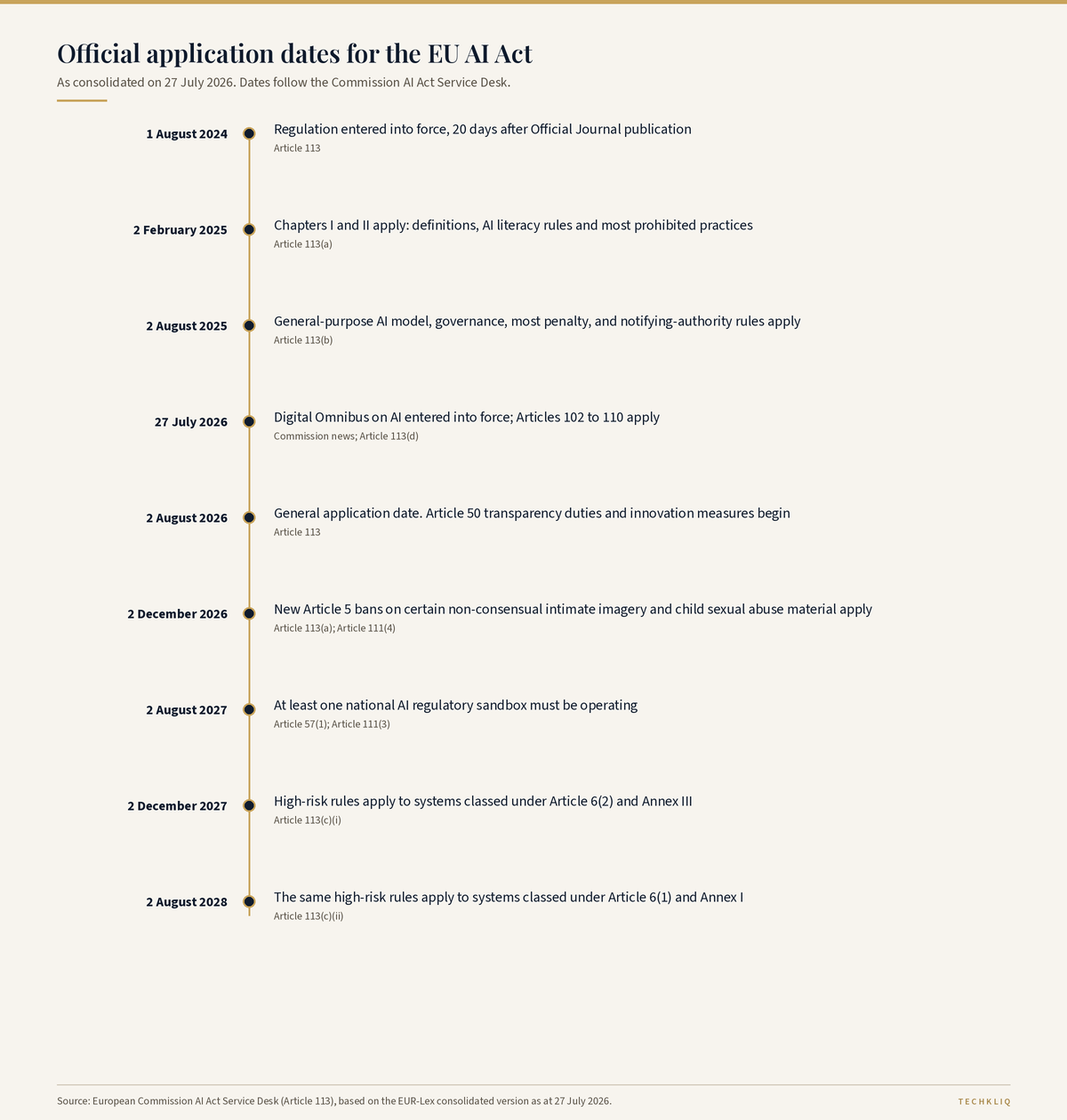
Figures follow the Commission’s AI Act Service Desk, which states that it displays the EUR-Lex consolidated version as at 27 July 2026.
| Date | What starts or started | Legal hook | Source |
|---|---|---|---|
| 1 August 2024 | Regulation entered into force, 20 days after Official Journal publication | Article 113 | Commission AI Act page; Article 113 |
| 2 February 2025 | Chapters I and II apply: definitions, AI literacy rules and most prohibited practices | Article 113(a) | Article 113; timeline FAQ |
| 2 August 2025 | General-purpose AI model, governance, most penalty, and notifying-authority rules apply (not Article 101) | Article 113(b) | Article 113 |
| 27 July 2026 | Digital Omnibus on AI entered into force; Articles 102 to 110 apply | Commission news; Article 113(d) | Commission news, 27 July 2026; Article 113 |
| 2 August 2026 | General application date. Article 50 transparency duties and innovation measures begin. The Commission also dates enforcement of already-applicable rules to this day | Article 113 | Article 113; Commission timeline |
| 2 December 2026 | New Article 5 bans on certain non-consensual intimate imagery and child sexual abuse material apply. Some synthetic-content systems already on the market before 2 August 2026 must meet Article 50(2) | Article 113(a); Article 111(4) | Article 113; Article 111 |
| 2 August 2027 | At least one national AI regulatory sandbox must be operating. Providers of general-purpose AI models placed on the market before 2 August 2025 must have taken the steps needed to comply | Article 57(1); Article 111(3) | Article 57; Article 111 |
| 2 December 2027 | High-risk rules in Chapter III, Sections 1 to 3, apply to systems classed under Article 6(2) and Annex III | Article 113(c)(i) | Article 113 |
| 2 August 2028 | The same high-risk rules apply to systems classed under Article 6(1) and Annex I, including AI embedded in many regulated products | Article 113(c)(ii) | Article 113; Commission AI Act page |
How this page was compiled
This page uses Regulation (EU) 2024/1689 as shown on the Commission’s AI Act Service Desk, which states that it follows the EUR-Lex consolidated version as at 27 July 2026, after Regulation (EU) 2026/1744 (the Digital Omnibus on AI) amended the Act. Dates and scope were checked against the Commission’s AI Act policy page, its 27 July 2026 news item, and the Service Desk implementation timeline. Law-firm blogs, vendor explainers and unsourced timelines were excluded. Figures are current as of 17 November 2026. If the Official Journal is amended again, this page should be updated. Corrections are covered by Techkliq’s editorial policy.
What is the EU AI Act?
The AI Act is a Union regulation. It sets harmonised rules for placing AI systems on the market, putting them into service and using them in the Union. It bans specified practices, sets requirements for high-risk systems, adds transparency duties for some systems, and regulates the placing on the market of general-purpose AI models (Article 1).
An “AI system” is a machine-based system designed to operate with varying levels of autonomy, which may adapt after deployment, and which infers from its input how to generate outputs such as predictions, content, recommendations or decisions (Article 3(1)). A “general-purpose AI model” is an AI model that displays significant generality, can perform a wide range of distinct tasks, and can be integrated into many downstream systems, with a research-and-prototyping exception before the model is placed on the market (Article 3(63)).
As a regulation, it applies directly in the Member States. Member States still set penalty rules and, by 2 August 2027, must have at least one national AI regulatory sandbox (Article 99(1); Article 57(1)).
Who does the EU AI Act apply to?
Article 2(1) applies the Act to:
- providers that place AI systems on the market or put them into service in the Union, or that place general-purpose AI models on the Union market, whether the provider is established inside the Union or in a third country
- deployers of AI systems established or located in the Union
- providers and deployers established or located in a third country, where the output produced by the AI system is used in the Union
- importers and distributors of AI systems
- product manufacturers that place an AI system on the market or put it into service together with their product, under their own name or trademark
- authorised representatives of providers not established in the Union
- affected persons located in the Union
A provider develops an AI system or general-purpose AI model, or has one developed, and places it on the market or puts the system into service under its own name or trademark, whether or not money changes hands (Article 3(3)). A deployer uses an AI system under its authority, except in the course of a personal, non-professional activity (Article 3(4)).
Keeping servers, staff or incorporation outside the EU does not, by itself, take a firm out of scope. If it places a system or model on the Union market, or if the system’s output is used in the Union, Article 2 can still reach it. Recital 22 gives the example of an operator in the Union contracting work to a third-country operator, with data sent out of the Union and the output sent back in.
The Act does not apply to areas outside Union law, or to AI systems used exclusively for military, defence or national security purposes (Article 2(3)). Systems or models developed and put into service solely for scientific research and development are outside it, as is research, testing or development work before a system or model is placed on the market or put into service, though testing in real-world conditions is not covered by that exclusion (Article 2(6) and 2(8)). Natural persons using AI in a purely personal, non-professional activity are not under deployer obligations (Article 2(10)). The Act also does not apply to AI systems released under free and open-source licences, unless they are placed on the market or put into service as high-risk systems, or as a system that falls under Article 5 or Article 50 (Article 2(12)).
What official dates matter now?
The table above is drawn from Article 113 and related provisions. The Commission dates entry into force to 1 August 2024, the twentieth day after publication in the Official Journal (Commission AI Act page). Application is staged: some chapters began in 2025, the general date was 2 August 2026, and the main high-risk duties now start later. The Commission’s Service Desk also treats 2 August 2026 as the start of Article 50 transparency duties, the innovation measures, and enforcement of already-applicable rules (Service Desk timeline).
Systems already on the market have extra time in some cases. Providers of general-purpose AI models placed on the market before 2 August 2025 have until 2 August 2027 to take the steps needed to comply (Article 111(3)). For most other high-risk systems already on the market or in service before the Chapter III application date, the Act applies only if, from that date, the system is subject to significant changes in its design. Providers and deployers of high-risk systems intended for use by public authorities must comply by 2 August 2030 in any case (Article 111(2)). Providers of systems that generate synthetic audio, image, video or text, and that were already on the market before 2 August 2026, must comply with the machine-readable marking duty in Article 50(2) by 2 December 2026 (Article 111(4)).
What did the Digital Omnibus on AI change?
On 27 July 2026, the Commission announced that the Digital Omnibus on AI had entered into force across the EU (Commission news, 27 July 2026). The Service Desk’s consolidated Article 113 now records the amended dates.
Chapter III, Sections 1, 2 and 3, with the exception of Article 6(5), apply from 2 December 2027 for AI systems classified as high-risk under Article 6(2) and Annex III, and from 2 August 2028 for systems classified as high-risk under Article 6(1) and Annex I (Article 113(c)). The Commission gives lifts and toys as examples of the second group (Commission AI Act page).
The Omnibus also added new Article 5 prohibitions covering certain non-consensual intimate imagery and child sexual abuse material, subject to the conditions in Article 5(1)(ba), (bb), 1a and 1b. Those points apply from 2 December 2026 (Article 5; Article 113(a)). Pages that still date the main high-risk rules to 2 August 2026, or to 2 August 2027 for all product-embedded systems, are out of date.
What is banned, and what counts as high-risk?
Article 5 lists the prohibited practices. The bans in force since 2 February 2025 include certain harmful manipulative or deceptive techniques, social scoring with specified harmful effects, some criminal-offence risk prediction based solely on profiling or personality traits, untargeted scraping of facial images from the internet or CCTV, emotion recognition in workplaces and education institutions (with a medical or safety exception), certain biometric categorisation that infers protected characteristics, and real-time remote biometric identification in publicly accessible spaces for law enforcement, subject to narrow authorisation conditions. Each item has statutory exceptions. For a specific case, use the article itself.
High-risk systems sit on a different track. Under Article 6(1), a system is high-risk when it is a product, or a safety component of a product, covered by Union harmonisation legislation in Annex I, and that product (or the system itself) must undergo a third-party conformity assessment for health and safety purposes. Under Article 6(2), systems listed in Annex III are also high-risk, unless a derogation in Article 6(3) applies. A system that profiles natural persons is always high-risk (Article 6(3)).
Annex III groups those use cases into eight areas: biometrics, where use is otherwise permitted; safety components in critical digital infrastructure, road traffic, or the supply of water, gas, heating or electricity; education and vocational training; employment, workers’ management and access to self-employment; access to essential private and public services and benefits, including some credit-scoring and life or health insurance pricing; law enforcement, where use is otherwise permitted; migration, asylum and border control management; and the administration of justice and democratic processes. The annex describes each use case more narrowly than those headings.
Some systems that are not high-risk still have transparency duties from 2 August 2026, including machine-readable marking of certain synthetic outputs and disclosure duties for deep fakes, some public-interest text, and certain emotion-recognition or biometric-categorisation systems (Article 50). General-purpose AI models have been regulated since 2 August 2025. A model is presumed to have “high-impact capabilities,” and may therefore be classed as a model with systemic risk, when the cumulative computation used for its training, measured in floating-point operations, is greater than 10^25 (Article 51(2)).
What are the fines?
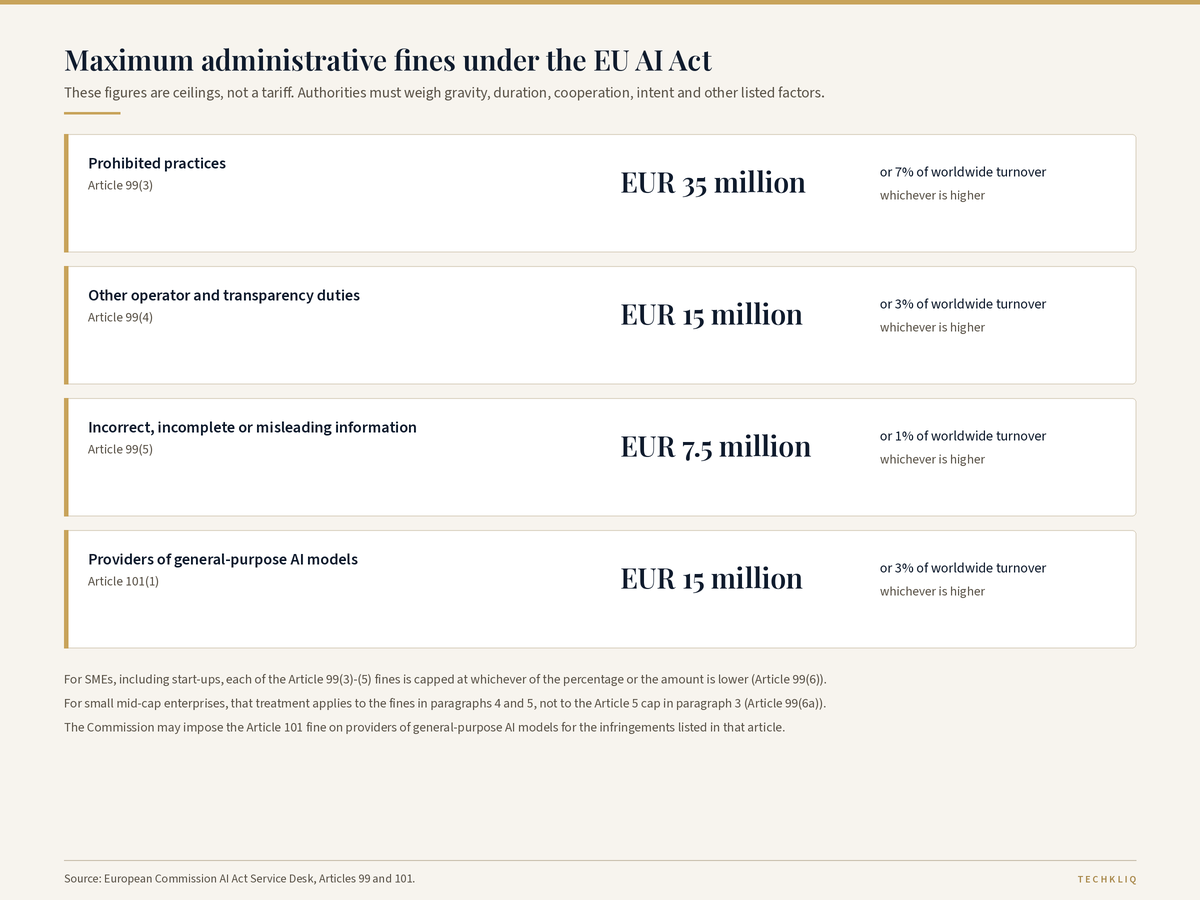
Member States must lay down penalties that are effective, proportionate and dissuasive (Article 99(1)). The regulation also sets upper limits:
- a breach of the Article 5 prohibitions: up to EUR 35 million, or, if the offender is an undertaking, up to 7% of total worldwide annual turnover for the preceding financial year, whichever is higher
- a breach of a listed set of operator, notified-body and Article 50 transparency duties: up to EUR 15 million, or up to 3% of that turnover, whichever is higher
- supplying incorrect, incomplete or misleading information to notified bodies or national competent authorities: up to EUR 7.5 million, or up to 1% of that turnover, whichever is higher
For SMEs, including start-ups, each of those fines is capped at whichever of the percentage or the amount is lower (Article 99(6)). For small mid-cap enterprises, that treatment applies to the fines in paragraphs 4 and 5, not to the Article 5 cap in paragraph 3 (Article 99(6a)). The Commission may also fine providers of general-purpose AI models up to 3% of annual total worldwide turnover in the preceding financial year, or EUR 15 million, whichever is higher, for the infringements listed in Article 101 (Article 101(1)). Those figures are ceilings, not a tariff. Article 99(7) requires authorities to weigh gravity, duration, cooperation, intent and other listed factors.
FAQ
Does the EU AI Act apply to a company that is not established in the EU?
Yes, it can. The Act applies to providers that place AI systems on the market or put them into service in the Union, or that place general-purpose AI models on the Union market, “irrespective of whether those providers are established or located within the Union or in a third country.” It also applies to providers and deployers in a third country “where the output produced by the AI system is used in the Union” (Article 2(1)(a) and (c)).
Has the AI Act already started to apply?
Yes, in stages. It entered into force on 1 August 2024. Chapters I and II have applied since 2 February 2025, and general-purpose AI model rules since 2 August 2025. The general application date was 2 August 2026. High-risk duties in Chapter III, Sections 1 to 3, now apply from 2 December 2027 or 2 August 2028, depending on the system (Article 113).
When do the high-risk rules apply after the Digital Omnibus on AI?
For systems classified as high-risk under Article 6(2) and Annex III, Chapter III, Sections 1 to 3, apply from 2 December 2027. For systems classified as high-risk under Article 6(1) and Annex I, those sections apply from 2 August 2028 (Article 113(c)). The Digital Omnibus on AI entered into force on 27 July 2026 (Commission news, 27 July 2026).
Are open-source AI systems exempt?
Only in part. The Act “does not apply to AI systems released under free and open-source licences, unless they are placed on the market or put into service as high-risk AI systems or as an AI system that falls under Article 5 or 50” (Article 2(12)).
What is the maximum fine under the AI Act?
For a breach of the Article 5 prohibitions, administrative fines can reach EUR 35 million, or 7% of an undertaking’s total worldwide annual turnover for the preceding financial year, whichever is higher. Many other operator and transparency breaches can reach EUR 15 million or 3%. For SMEs, including start-ups, the cap is the lower of the amount or the percentage (Article 99(3), (4) and (6)). The Commission may fine providers of general-purpose AI models up to 3% of worldwide annual turnover or EUR 15 million, whichever is higher (Article 101(1)).
Sources
1. Regulation (EU) 2024/1689, Articles 1, 2, 3, 5, 6, 50, 51, 57, 99, 101, 111 and 113, and Annex III, as displayed in the European Commission AI Act Service Desk, based on the EUR-Lex consolidated version as at 27 July 2026. Retrieved 17 November 2026 (Asia/Calcutta). Starting point: Article 113.
2. European Commission, “AI Act,” Shaping Europe’s digital future. Describes entry into force on 1 August 2024, general application on 2 August 2026, and the amended high-risk dates. Retrieved 17 November 2026 (Asia/Calcutta). https://digital-strategy.ec.europa.eu/en/policies/regulatory-framework-ai
3. European Commission, “AI Omnibus enters into force,” news article, 27 July 2026. Retrieved 17 November 2026 (Asia/Calcutta). https://digital-strategy.ec.europa.eu/en/news/ai-omnibus-enters-force
4. European Commission AI Act Service Desk, “Timeline for the Implementation of the EU AI Act.” Retrieved 17 November 2026 (Asia/Calcutta). https://ai-act-service-desk.ec.europa.eu/en/ai-act/timeline/timeline-implementation-eu-ai-act
5. European Commission AI Act Service Desk, “When does the AI Act go into effect? What is its timeline for implementation?” Retrieved 17 November 2026 (Asia/Calcutta). https://ai-act-service-desk.ec.europa.eu/en/ai-act/faq/when-does-ai-act-go-effect-what-its-timeline-implementation
EUR-Lex official texts (the EUR-Lex site returned a WAF challenge from this drafting environment; identifiers were taken from Commission pages, and the operative wording was verified on the Service Desk): Regulation (EU) 2024/1689, https://eur-lex.europa.eu/eli/reg/2024/1689/oj; consolidated text as at 27 July 2026, https://eur-lex.europa.eu/eli/reg/2024/1689/2026-07-27; Regulation (EU) 2026/1744, https://eur-lex.europa.eu/eli/reg/2026/1744/oj.
Changelog
- 17 November 2026: Initial version, based on the AI Act as consolidated after the Digital Omnibus on AI entered into force on 27 July 2026.